Explore our network of country and industry based websites to access localized information, product offerings, and business services across our group.
Log in to start sending quotation requests for any product.
Don't have an account? Sign Up Here
Home Navigating Suez Canal Risk: Borax Pentahydrate Trade in Flux
Trade Insights | Applications and Buyers | 15 April 2026
Introduction
The Strategic Importance of Borax Pentahydrate
The Suez Canal: A Persistent Chokepoint for Chemical Trade
Projected Trade Flow Shifts for Borax by 2026
Strategic Sourcing and the Role of Specialized Distributors
Conclusion
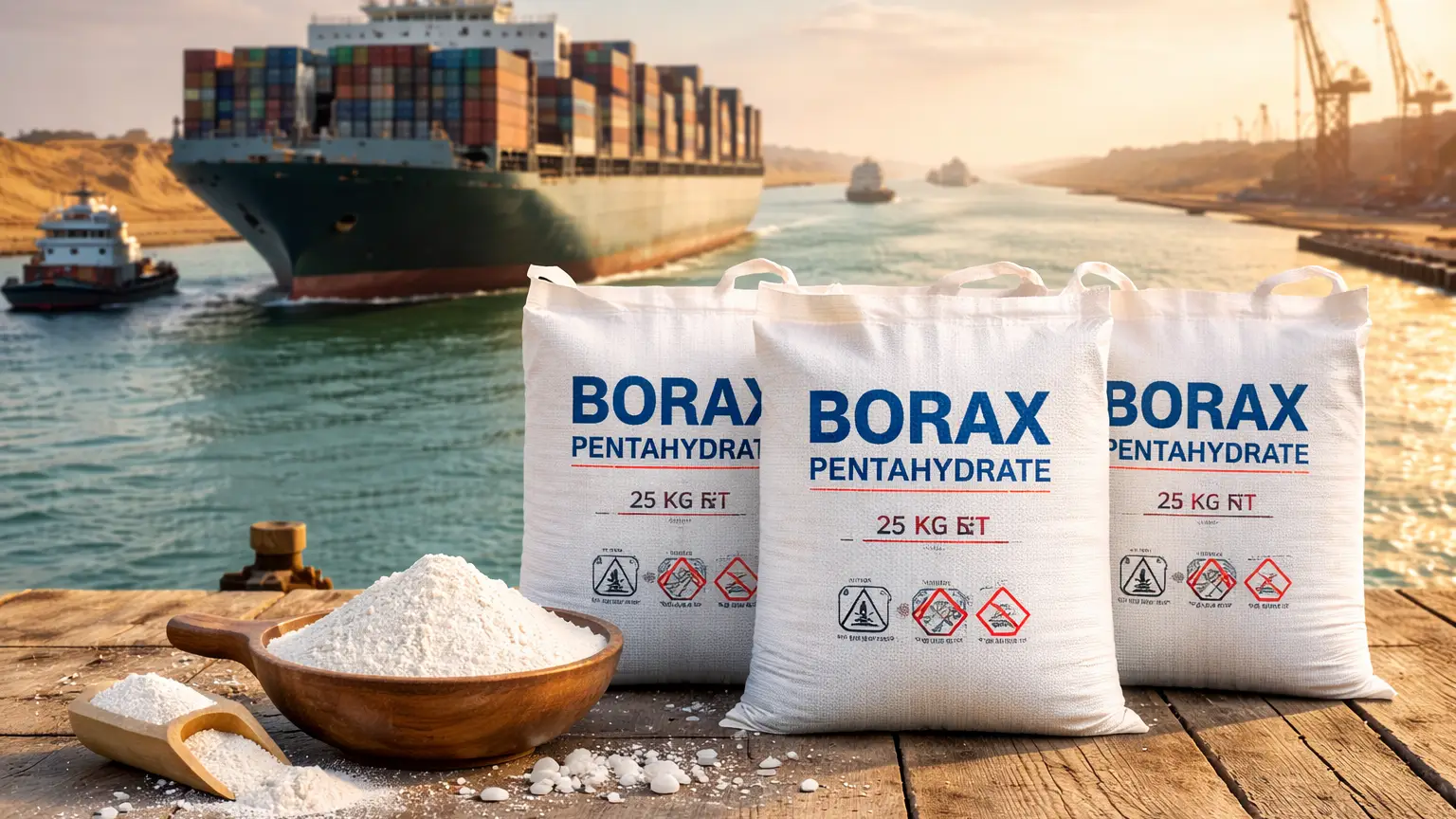
The global chemical supply chain is a complex and delicate ecosystem, highly sensitive to geopolitical and logistical disruptions. For critical industrial minerals like borax pentahydrate, a primary source of boron, these disruptions can have cascading effects across multiple sectors, from agriculture to ceramics and glass manufacturing. As we look towards 2026, a significant recalibration of trade routes is anticipated, driven primarily by the persistent and escalating risks associated with the Suez Canal. This vital maritime shortcut, responsible for facilitating approximately 12% of global trade, has transformed from a reliable conduit into a symbol of vulnerability.
This article provides a detailed analysis of how the compounded risks surrounding the Suez Canal—encompassing geopolitical tensions, piracy, and climate-induced volatility—are poised to fundamentally reshape the global trade flows of borax pentahydrate. We will examine the current supply landscape, project the likely shifts in sourcing and logistics strategies by 2026, and underscore the growing imperative for procurement managers and chemical buyers to develop resilient, diversified supply chains. The insights herein are crucial for stakeholders across the boron value chain to mitigate risk and ensure operational continuity.
Borax pentahydrate (Na2B4O7·5H2O) is not merely a commodity chemical; it is a foundational material for modern industry. Its unique properties, derived from its boron content, make it indispensable in a wide array of applications. In agriculture, it serves as a vital micronutrient fertilizer, correcting boron deficiencies in soils to improve crop yield and quality. The glass and ceramics industries are perhaps the largest consumers, where borax acts as a flux, lowering the melting temperature and improving the thermal shock resistance and durability of products like fiberglass, borosilicate glass (e.g., Pyrex), and ceramic glazes. Furthermore, its role in detergents, wood preservatives, and metallurgy cements its status as a workhorse of industrial chemistry.
The specifications of borax pentahydrate are critical for its performance. Typical commercial-grade material has a minimum B2O3 content of 46-48%, with low impurities of heavy metals and insoluble matter. Its pentahydrate form offers a balance between solubility and stability, making it preferable for many processes over the decahydrate or anhydrous forms. For manufacturers, consistent purity and particle size distribution are non-negotiable, as variations can directly impact production efficiency and final product quality. This underscores why secure, reliable, and quality-assured supply chains are paramount.
Geographically, global production is concentrated in a handful of regions. Turkey holds the world's largest reserves and is a leading producer, followed by the United States (from California's boron deposits), South America (primarily Chile and Argentina), and parts of Asia. Traditionally, these production hubs have relied on efficient maritime routes, with the Suez Canal being a critical artery for moving borax pentahydrate from the Mediterranean and the Middle East to markets in Asia, and vice-versa for some raw materials. Any disruption to this artery therefore sends shockwaves through the entire market.
The Suez Canal's vulnerability is a multi-faceted issue. The 2021 grounding of the Ever Given was a stark, singular event that halted traffic for six days, but it revealed a systemic fragility. Beyond such accidents, the region is plagued by deeper, more persistent threats. Geopolitical instability in the surrounding areas, notably the ongoing conflicts and tensions in the Red Sea and Gulf of Aden, has led to increased attacks on commercial shipping. This has forced many carriers to reconsider transit, opting for longer, costlier alternative routes to ensure crew and cargo safety.
Furthermore, climate change introduces another layer of risk. Rising sea levels and unpredictable weather patterns could affect the canal's operations, while water scarcity issues in Egypt itself may impact its maintenance and expansion capabilities. For chemical shippers, including those transporting borax pentahydrate, these risks are magnified. Chemical cargoes often have specific storage and transit requirements, and delays can lead to product degradation, contractual penalties, and production stoppages for buyers. The "just-in-time" inventory model common in many industries becomes untenable when a key transit point is unreliable, pushing companies to hold larger safety stocks at a significant carrying cost.
The financial impact is already being felt. War risk insurance premiums for vessels transiting the Red Sea have skyrocketed, and the cost of rerouting via the Cape of Good Hope adds weeks to voyage times and burns significantly more fuel. These increased freight costs are inevitably passed down the supply chain, contributing to price volatility for bulk chemicals like borax pentahydrate. By 2026, these are not hypothetical risks but established market realities that procurement strategies must actively address.
By 2026, the global trade map for borax pentahydrate is expected to look markedly different. We anticipate a strategic pivot away from over-reliance on Suez-dependent routes. For European and North African consumers who traditionally sourced from Turkey via the Mediterranean and Suez, there will be a stronger push for regional consolidation. This may involve securing more material from European stockpiles or negotiating direct, shorter sea or land routes that bypass the canal entirely, even if at a slightly higher base cost.
The most dramatic shift will likely occur in the Asia-Pacific region. Countries like India, China, and Southeast Asian nations, which import significant quantities of borates, will aggressively diversify their sources. While Turkish material may still be sourced, it will increasingly travel via the longer Cape of Good Hope route, building longer lead times into supply contracts. More consequentially, Asian buyers will turn more intently to suppliers in the Americas. We project a substantial increase in shipments of borax pentahydrate from the U.S. (West Coast) and South America to Asia, traveling across the Pacific. This re-routing strengthens trade ties across the Pacific basin and may spur investment in port infrastructure in Southeast Asia to handle increased volumes from the east.
This geographical diversification will also influence pricing structures. The era of a single benchmark price may give way to more regionalized pricing, reflecting the distinct logistics costs from different source origins. For instance, borax pentahydrate landed in India from Chile may carry a different cost structure than material from Turkey, even before accounting for quality differentials. Procurement teams will need sophisticated tools and market intelligence to navigate this new, multi-polar pricing landscape effectively.
In this evolving, high-risk environment, the role of specialized, global chemical distributors becomes not just valuable, but critical. Companies can no longer afford a linear, single-source procurement strategy. Partnering with a distributor with a truly global network, such as those operating under the chemtradeasia and borontradeasia banners across key hubs like Singapore (.sg), the UAE (.ae), Indonesia (.co.id), and India (.in), provides a vital buffer against regional disruptions. These distributors maintain multi-sourced supply lines, offering buyers optionality and resilience.
A premier distributor provides far more than just logistics. They offer market intelligence, forecasting potential disruptions and price movements based on real-time geopolitical and trade data. They manage the complex documentation, regulatory compliance (including providing essential Safety Data Sheets or SDS), and quality assurance processes, ensuring that every batch of borax pentahydrate meets stringent specifications. For buyers, this transforms procurement from a transactional headache into a strategic, value-added function that protects the core business from supply shocks.
Furthermore, established distributors facilitate flexible sourcing. If a shipment from the Eastern Mediterranean is delayed, a capable partner can often tap into an alternative supply from a different regional hub—for example, sourcing from a verified stockpile in Asia-Pacific via chemtradeasia.sg or from the Middle East via chemtradeasia.ae—to keep a client's production line running. This level of agility, underpinned by deep industry expertise and a physical network, is what will separate thriving companies from struggling ones in the 2026 boron market.
The trajectory is clear: the Suez Canal's role as the linchpin of East-West chemical trade is diminishing due to unsustainable risks. For the borax pentahydrate market, the period leading to 2026 will be defined by a great logistical reorientation. Trade flows will decentralize, sourcing will diversify, and supply chains will be redesigned with resilience as a core KPI. Success in this new paradigm will belong to those who proactively engage with these trends, leveraging data, forging strategic partnerships, and building flexibility into their procurement DNA.
The shift presents both a challenge and an opportunity. It challenges traditional cost-centric models but offers the opportunity to build more robust, transparent, and reliable supply networks. By understanding these impending changes and collaborating with expert partners who navigate the global boron landscape daily, businesses can turn a potential vulnerability into a competitive advantage, securing their supply of this critical industrial material for the long term.
Disclaimer: This article is for informational and market insight purposes only. It is not intended as technical, safety, or professional advice. The data and projections presented are based on current market analysis and are subject to change. Readers are strongly advised to verify all information independently, consult official technical documentation such as Material Safety Data Sheets (MSDS/SDS) for specific products, and seek guidance from qualified experts for their particular applications and circumstances. For specific inquiries regarding borax pentahydrate sourcing or applications, please contact our professional team directly.
We're committed to your privacy. Tradeasia uses the information you provide to us to contact you about our relevant content, products, and services. For more information, check out our privacy policy.


 English
 Indonesian
 简体字
简体字
 العربية
 Español
 Français
 Português
 日本語
日本語
 한국어
한국어
 Tiếng Việt



















