Explore our network of country and industry based websites to access localized information, product offerings, and business services across our group.
Log in to start sending quotation requests for any product.
Don't have an account? Sign Up Here
Home Borax Pentahydrate Supply Chain & Bulk Sourcing Intelligence Guide 2026
Trade Insights | Supply Chain | 21 May 2026
Rio Tinto's Q1 2026 operations report, released April 21, contains a single sentence that procurement managers sourcing U.S. Borax product need to read carefully: "We are advancing our strategic reviews and are now actively testing the market for our Borates business."
That sentence changes the calculus for any industrial buyer with annual term contracts tied to California production. The U.S. Borax facility at Boron, California — one of only two commercial borax pentahydrate production sites in the world — is now officially subject to a market sale process. An ownership transition introduces contract continuity risk, potential capital investment delays, and the possibility of operational disruption during any handover period. Buyers who treat this as background news rather than a sourcing event are mispricing the risk.
This guide maps the full borax pentahydrate supply chain, dissects the Eti Maden vs. U.S. Borax comparison across specifications, trade routes, and pricing, and provides the procurement framework industrial buyers need to act ahead of the market rather than react to it.
Two operations control virtually the entire global supply of refined borax pentahydrate. No third-scale producer exists.
Eti Maden (Turkey): Turkey's state-owned borate enterprise, operating under the Turkey Wealth Fund, held approximately 47% of global borate mineral production in 2012 — and that share has grown since. Its Bandırma Boron and Acid Factories complex on the Sea of Marmara processes ore sourced from the Kırka and Bigadiç mines, producing approximately 400,000 tonnes of refined boron products annually across its full product range. Its ETIBOR-48 brand — which takes its name from the guaranteed minimum 48% B₂O₃ content — is the global benchmark for borax pentahydrate quality. Eti Maden's Asia-Pacific sales operate through a dedicated regional entity, Etimaden Asia Pacific Limited, covering China, Vietnam, the Philippines, Indonesia, Thailand, Singapore, Malaysia, and several adjacent markets.
Turkey's structural advantage is not just geological. Subsidized domestic energy, vertically integrated mine-to-refinery operations, and a government mandate to grow value-added borate exports from the Bandırma complex give Eti Maden a cost position that privately owned North American producers cannot replicate on equivalent terms.
Rio Tinto / U.S. Borax (United States): The Boron, California operation — roughly 100 miles northeast of Los Angeles in the Mojave Desert — is one of the largest open-pit borate mines in the world, processing kernite and ulexite ore into refined borate products including borax pentahydrate (marketed as Neobor), borax decahydrate (marketed as Optibor), and anhydrous borax. Rio Tinto held approximately 23% of global borate production share in 2012. The California operation feeds export sales through the Port of Los Angeles/Long Beach, primarily into Asian and Latin American markets.
The Q1 2026 disclosure that Rio Tinto is "actively testing the market" for its Borates business represents a significant escalation from prior signals. Rio Tinto's strategic portfolio simplification — which has already produced the pending review of its Iron & Titanium business — now explicitly includes Borates. A divestiture to a financial buyer, a strategic chemical company, or a sovereign entity would transfer ownership of the only large-scale U.S. source of borax pentahydrate. Buyers on multi-year supply agreements will need to monitor contract assignment clauses and counterparty continuity provisions closely.
| Producer | Origin | Annual Boron Product Output | Primary Export Ports | Market Position |
|---|---|---|---|---|
| Eti Maden | Bandırma, Turkey | ~400,000 mt refined boron products | Bandırma port (Sea of Marmara) | ~47%+ global borate minerals share |
| Rio Tinto / U.S. Borax | Boron, California, USA | Significant capacity (exact mtpa not publicly disclosed) | Los Angeles/Long Beach | ~23% global borate production share (2012 basis) |
| Searles Valley Minerals | Trona, California, USA | Limited volume; V-Bor pentahydrate | US West Coast | Minor / domestic-focused |
Borax pentahydrate is not interchangeable with the other major borate forms in high-performance industrial applications. The specification decision has direct cost and process consequences.
Borax pentahydrate (Na₂B₄O₇·5H₂O) contains approximately 47–48% B₂O₃ by weight. Borax decahydrate (Na₂B₄O₇·10H₂O) carries approximately 36.5% B₂O₃. Anhydrous borax (Na₂B₄O₇) delivers 68.2% B₂O₃. The choice between these forms is not primarily a cost decision — it is an application and process decision.
For fiberglass and flat glass manufacturers: pentahydrate is the preferred form. Its higher B₂O₃ concentration means that 74.6 kg of pentahydrate delivers the same active boron as 100 kg of decahydrate. In a continuous glass melting furnace processing hundreds of tonnes per day, that 25% reduction in batch weight per unit of active boron translates directly into lower energy consumption, less water vapor to drive off during melting, reduced foaming in the melt, and higher furnace throughput. These are not marginal gains — for a glass manufacturer running 24/7 production, the energy cost differential over a year is material.
| Specification Parameter | Borax Pentahydrate | Borax Decahydrate | Anhydrous Borax |
|---|---|---|---|
| Chemical Formula | Na₂B₄O₇·5H₂O | Na₂B₄O₇·10H₂O | Na₂B₄O₇ |
| CAS Number | 12179-04-3 | 1303-96-4 | 1330-43-4 |
| HS Code | 2840.19.10 | 2840.19.90 | 2840.11 |
| B₂O₃ Content (% by weight) | ~47–48% | ~36.5% | ~68.2% |
| Equivalent weight vs. Decahydrate | 74.6 kg = 100 kg decahydrate | — | ~54 kg = 100 kg decahydrate |
| Physical form | White crystalline granules | White crystalline powder/granules | White powder/glass |
| Moisture sensitivity / caking risk | Moderate — requires sealed packaging | Higher — absorbs ambient moisture readily | Low — hygroscopic but no free water |
| Primary industrial use | Fiberglass, glass, ceramics, agriculture | Detergents, glass, cleaning | Specialty glass, metallurgy, electronics |
| Storage requirement | Cool, dry, sealed. Max moisture 0.5% on delivery | Dry, shaded. More prone to caking on humidity exposure | Sealed; absorbs atmospheric moisture |
Decahydrate's higher water content makes it more prone to caking and recrystallization in humid storage environments — a logistics liability on long ocean transits to tropical destinations. Pentahydrate's lower inherent moisture makes it more stable in transit but still sensitive to condensation ingress in poorly sealed containers.
The agricultural micronutrient market is the one sector where all three forms compete directly on a price-per-boron basis. For soil application, the active boron content delivered per hectare matters most, and buyers in this segment tend to be more price-elastic than glass or ceramics buyers.
Boron is not optional in E-glass formulations. Approximately 5–6% B₂O₃ by mass is required in the glass batch to control viscosity during fiber drawing, reduce the liquidus temperature, and maintain the electrical resistivity properties that define E-glass for printed circuit boards and structural composites. The global construction industry growing at approximately 4% annually sustains consistent base demand for fiberglass insulation. The energy transition is the incremental driver: wind turbine blades use glass fiber reinforcement, and solar panel production requires borosilicate glass frames with tight B₂O₃ specifications.
Asia-Pacific holds 48% of global borax pentahydrate consumption in 2024, reflecting the concentration of fiberglass manufacturing capacity in China, India, and Southeast Asia. Chinese fiberglass producers — including Jushi Group and Chongqing International Composite — operate continuous furnaces that require consistent boron supply with tight B₂O₃ variance tolerance across deliveries. For these buyers, switching between Turkish and U.S. origin product within a production run creates formulation adjustment risk and is actively avoided. Origin consistency, not price alone, determines purchasing behavior.
The global solar PV glass market is projected to reach USD 22.05 billion by 2026. Solar glass — particularly in bifacial and glass-glass module architectures — requires borax pentahydrate to raise thermal resistance and improve durability against UV degradation. India's government mandates for domestically produced solar cells and panels are accelerating local solar glass capacity, creating a new major regional demand center. Indian prices for borax pentahydrate reached approximately USD 1,047/mt CFR in Q4 2025, up roughly 8.35% in the quarter alone, driven by tight import supply from Turkey and the United States.
Specialty glass applications including LCD panel substrates, pharmaceutical glass tubing, and telescope mirror blanks specify borosilicate compositions that cannot substitute lower B₂O₃ content borate forms. These are low-volume but specification-critical segments where pentahydrate's consistent B₂O₃ content is non-negotiable.
Boron deficiency is recognized as the second most widespread micronutrient deficiency in soils globally. Borax pentahydrate dissolves at a controlled rate, making it effective as a broadcast or fertigation boron source for boron-sensitive crops including canola, sunflower, cotton, and certain fruit trees. Demand from the agricultural sector follows seasonal planting calendars — procurement windows in South Asia and Southeast Asia peak ahead of the Rabi crop cycle (October–November) and the Kharif cycle (June–July). Buyers in this segment are more price-sensitive than glass manufacturers and more willing to switch between Turkish and U.S. origins based on landed cost.
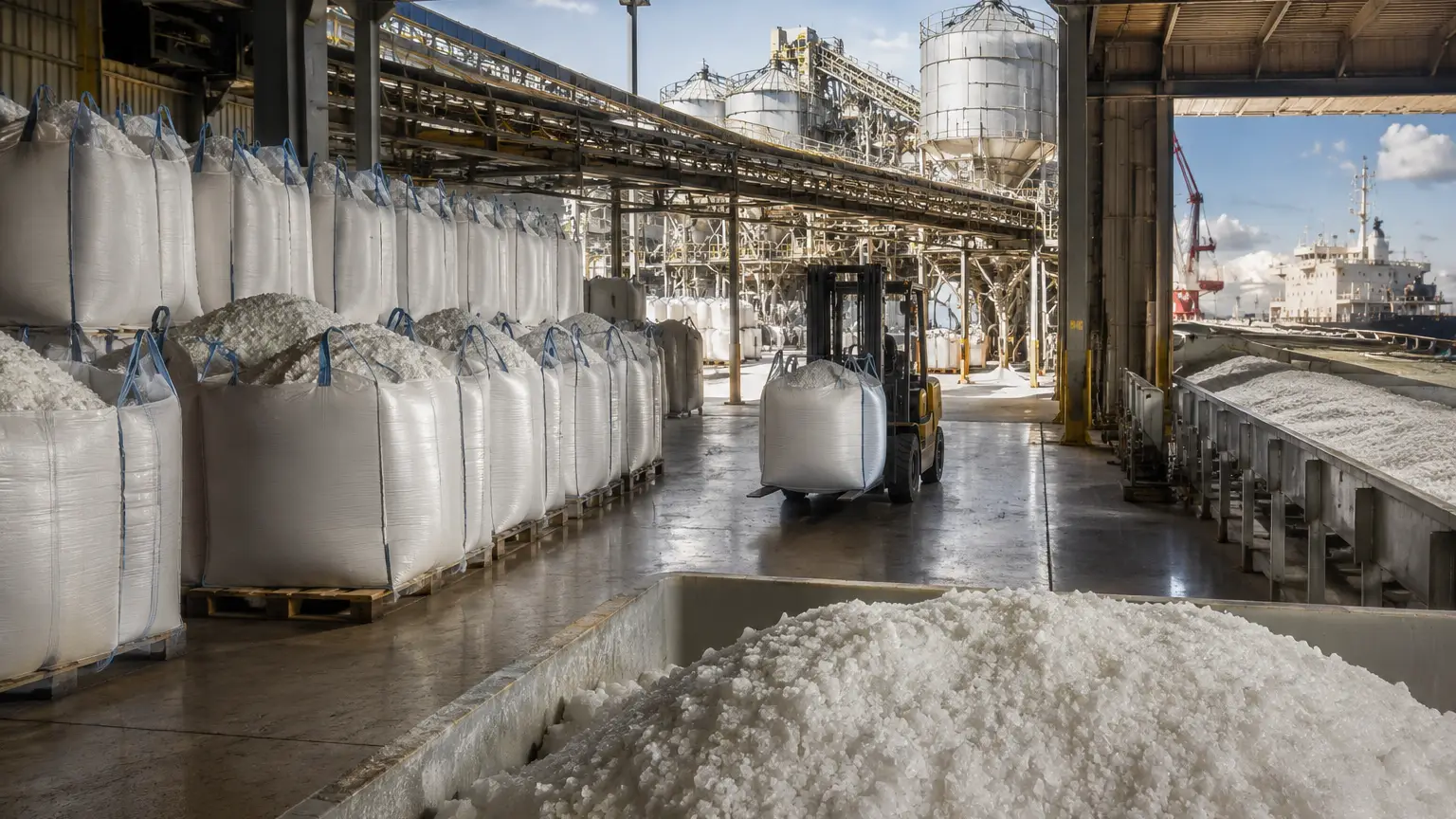
Borax pentahydrate is classified as a non-hazardous cargo under standard maritime regulations, but it is not a passive shipment. Atmospheric humidity during ocean transit can cause surface rehydration — the granular product absorbs ambient moisture and begins migrating toward the more stable decahydrate phase, producing surface caking that fuses granules into hard lumps. In bulk vessel shipments, this creates handling and discharge problems at the destination terminal. In containerized Full Container Load (FCL) shipments, caking is controlled through multi-layer PE-lined bags inside 25 kg or 1,000 kg FIBC (big bag) formats, combined with container desiccants and careful moisture management during loading.
Eti Maden ships from Bandırma port through the Sea of Marmara and either the Bosphorus Strait (for global transit) or directly into the Mediterranean. Transit times from Turkey to the Indian subcontinent average 18–22 days; to China and Southeast Asia, 25–35 days via the Suez Canal. U.S. Borax product ships from Los Angeles/Long Beach with transit times of 15–25 days to Northeast Asia and 20–30 days to Southeast Asia on trans-Pacific container services.
The critical monitoring requirement on any long-transit pentahydrate shipment is container humidity. Industry practice calls for two to four 500g silica gel desiccant sachets per 1 mt of cargo, with container floor lined against moisture ingress. Any break in the packaging seal during transit — from rough handling, condensation on container walls, or hull temperature changes — can compromise an entire container lot. Buyers receiving bulk FCL shipments should inspect for caking before discharge and document any condition deviations against the certificate of analysis issued at origin.
| Logistics Format | Typical Parcel Size | Suited For | Key Advantage | Key Risk |
|---|---|---|---|---|
| Bulk vessel (break-bulk) | 1,000–5,000 mt | Very large-volume glass/fiberglass manufacturers | Lowest freight cost per tonne | Cargo hold contamination; caking in holds; minimum volume requirements |
| FCL (20ft or 40ft) | 20–25 mt per 20ft FCL | Mid-volume buyers across all sectors | Controlled moisture management; flexible parcel size | Higher freight per tonne vs. bulk |
| FIBC big bags in FCL | 1,000 kg/bag, 20–25 bags per FCL | Feed mills, ceramic frit producers, agricultural distributors | Easy warehousing; no repackaging at destination | Bag integrity under stacking pressure on long voyages |
| 25 kg multi-wall bags | 600–800 bags per 20ft FCL | Specialty buyers; agricultural distributors | Unit-level specification control; retail-ready format | Highest freight cost per tonne of active boron |
Borax pentahydrate is classified under HS 2840.19.10 (disodium tetraborate pentahydrate) at the 8-digit level in the EU Combined Nomenclature, and under HTS 2840.19.00.00 in the United States. The broader 6-digit HS 2840.19 heading covers all non-anhydrous refined borax, with anhydrous forms classified separately under 2840.11.
Import duty rates under HS 2840.19 vary materially by destination:
A customs misclassification between HS 2840.19.10 (pentahydrate) and 2840.19.90 (other non-anhydrous borax, including decahydrate) can create post-import duty reassessments. Buyers should ensure their customs broker distinguishes the hydrate form in the declaration — a distinction that several national customs authorities have been tightening scrutiny on.
The Rio Tinto Borates strategic review is not the only risk in this market. The duopoly structure creates concentration risk regardless of who owns the California operation. Five risk dimensions are worth evaluating explicitly.
| Risk Dimension | Eti Maden (Turkey) | U.S. Borax (California) | Risk Rating |
|---|---|---|---|
| Ownership/continuity risk | State-owned entity; low ownership change risk | Strategic review active; sale process ongoing | USX: HIGH / ETI: LOW |
| Geopolitical disruption | Bosphorus transit; Turkey-EU trade relations | Trans-Pacific freight; Red Sea route avoidance | ETI: MEDIUM / USX: LOW |
| HPAI/weather/force majeure | Seismic activity in western Turkey | Mojave Desert: water supply and climate constraints | MEDIUM for both |
| Regulatory compliance (EU REACH) | Full REACH compliance; authorized uses defined | Same regulatory status; SVHC classification applies | MEDIUM for both |
| Single-origin concentration risk | Buyers relying solely on Turkish origin have no backup if Eti Maden restricts exports | Buyers relying solely on U.S. origin face strategic review uncertainty | HIGH for single-source buyers of either origin |
The REACH SVHC classification adds a layer of compliance complexity that any buyer supplying into the European market must manage. Borax pentahydrate (along with other sodium borate compounds) is classified as a Substance of Very High Concern under REACH for reproductive toxicity — Category 1B under the EU CLP Regulation (H360FD: may damage fertility, may damage the unborn child). This classification has been in force since 2015, with ECHA's November 2025 12th Recommendation extending SVHC scrutiny to additional borate derivatives. The practical implications:
Turkey's Eti Maden has maintained full REACH compliance and continues to hold authorization for industrial uses under the Authorisation framework. This is not a barrier to supply — it is a documentation and compliance management requirement that differentiates reputable suppliers from informal intermediaries.
Procurement teams managing borax pentahydrate supply across multiple geographies and end-use applications — particularly those facing both the U.S. Borax ownership uncertainty and EU REACH compliance requirements simultaneously — benefit from working with a distributor that maintains active multi-origin sourcing capability and compliance documentation management. Tradeasia International, a Singapore-headquartered global chemical distributor with over 20 years of supply chain experience, supplies borax pentahydrate to industrial buyers across glass, fiberglass, ceramics, and agricultural markets globally, with both Eti Maden (ETIBOR-48) and U.S. Borax (Neobor) origin options, REACH-compliant SDS documentation, origin-specific COA and specification verification, and logistics coordination covering FCL and bulk vessel formats. Buyers managing term contract exposure during the Rio Tinto strategic review period can contact Tradeasia International for origin diversification strategies and volume pricing across both supply origins.
Borax pentahydrate pricing is shaped by three variables in descending order of near-term impact: energy costs at the Bandırma and Boron processing plants, the USD/TRY exchange rate on Turkish-origin product, and freight rates on key trade lanes.
Recent price trajectory:
The energy component is material. Turkey's borax refining at Bandırma is energy-intensive; rising diesel and electricity costs in 2025 contributed to a 5.2% price increase in North American borax pentahydrate and approximately 8% in Turkish-origin product. Any sustained elevation in global energy prices — particularly European natural gas, which Turkish grid energy partially tracks — will feed into Eti Maden offtake pricing with a 30–90 day lag.
Procurement strategy for current conditions:
The combination of the Rio Tinto strategic review, structurally firm energy costs, and rising Asian demand creates a price environment tilted toward firmness through H2 2026. Buyers on annual term contracts should evaluate whether their current agreements include assignment consent provisions — if the Borates business changes hands, buyers need clarity on whether existing contract terms carry over to a new owner without renegotiation.
For spot buyers and those approaching contract renewal: dual-origin positioning between Turkish ETIBOR-48 and U.S. Borax product provides price optionality and supply continuity coverage. The 30-day buffer stock recommendation applies to most industrial buyers, though fiberglass manufacturers with single-origin supply and high daily consumption should carry 45–60 days of inventory given the current ownership uncertainty on U.S. supply.
Buyers with agricultural applications and seasonal purchasing windows should front-load their pre-season procurement. If the Rio Tinto process generates buyer interest and a sale announcement during H2 2026, spot market availability from U.S. origins could tighten as term contract customers accelerate purchases.
The borax pentahydrate market does not have a third-origin escape route. There is no emerging producer at Eti Maden or U.S. Borax scale — the world's commercially viable borate mineral deposits are overwhelmingly concentrated in Turkey and the Mojave Desert. This means dual-sourcing is not a true risk hedge the way it might be in a multi-origin commodity; it is origin diversification within a duopoly.
The practical framework for procurement teams:
If currently 100% Turkish-origin (ETIBOR-48): The Eti Maden supply chain is stable — state ownership and a government export mandate make unilateral supply disruption unlikely. The risk is longer-term: any Turkish government policy shift on strategic mineral exports, a major seismic event in the Bandırma region, or a Bosphorus transit disruption would leave single-origin buyers fully exposed. Maintain a minimum 30-day inventory buffer; test U.S. Borax product in one annual contract parcel to qualify the alternative in your formulations.
If currently 100% U.S. Borax (Neobor): The strategic review is the active risk. Qualify ETIBOR-48 product against your existing B₂O₃ content, granule size, and impurity specifications now — before a change in ownership or operational disruption forces an emergency switch under time pressure. The products are chemically equivalent; the differences are in granulometry, bulk density, and trace impurity profiles that matter for glass batch formulations and agricultural dispersal rates.
For buyers managing both origins: Maintain split sourcing at a ratio that reflects your geographic logistics economics — Turkish origin is cheaper to deliver into Europe and South Asia; U.S. origin is typically cheaper into the Americas and, for some trade lanes, into Northeast Asia. Revisit that ratio quarterly during the Rio Tinto strategic review period.
We're committed to your privacy. Tradeasia uses the information you provide to us to contact you about our relevant content, products, and services. For more information, check out our privacy policy.


 English
 Indonesian
 简体字
简体字
 العربية
 Español
 Français
 Português
 日本語
日本語
 한국어
한국어
 Tiếng Việt




















