Explore our network of country and industry based websites to access localized information, product offerings, and business services across our group.
To view and access the document, you are required to sign in to your account first.
Don't have an account? Sign Up Here
Home Boric Acid Price Index 2026: The Influence of Energy and Refining Costs
Pricing Indices | 17 April 2026
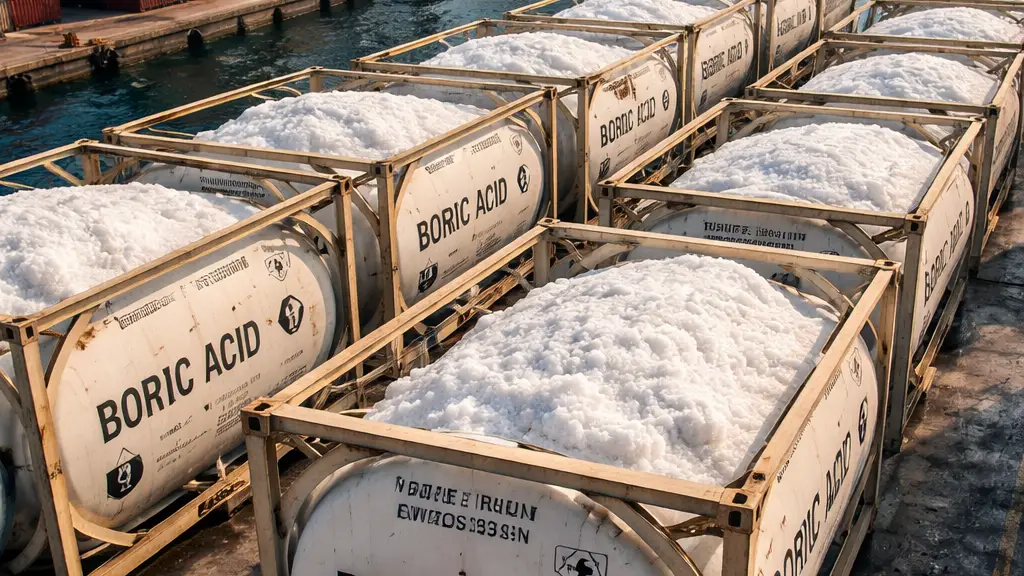
Global boric acid prices are forecast in the USD 1.25–1.45/KG range in 2026, per Expert Market Research, with Northeast Asia trading significantly above the global average at approximately USD 2.46/KG due to import dependency and premium electronics-grade demand. The primary pricing driver is the energy cost embedded in multi-stage calcination refining, where Eti Maden's subsidized Turkish electricity rates structurally undercut non-Turkish producers. In the base case, global prices hold stable with modest upward pressure from fiberglass and semiconductor demand; the primary downside risk is a further contraction in European construction activity, which remains the market's weakest end-use segment.
The boric acid market entered 2026 in a state of regional divergence rather than uniform global pricing. Northeast Asia continues to trade at a steep premium, while North America records the weakest pricing of any major hub. That spread is not an anomaly — it reflects structural differences in import dependency, freight exposure, and end-use mix.
| Benchmark Hub | Approximate Price (Q4 2025 / Q1 2026) | Change vs. Q1 2025 | Primary Driver | Source |
|---|---|---|---|---|
| Northeast Asia | USD 2.46/KG | Mild decline | Electronics/ceramics import premium | Expert Market Research |
| Global Average | USD 1.29/KG | Flat | Balanced industrial demand | Expert Market Research |
| Europe | USD 1.03/KG | +Moderate | Construction drag offset by regulatory premium | Expert Market Research |
| South America | USD 0.87/KG | +2.4% (Q4 2025) | Export demand growth | Expert Market Research |
| North America | USD 0.81/KG | -7.5% (Q3 2025) | Fiberglass/construction demand weakness | Expert Market Research |
Table reflects Q4 2025 regional data per Expert Market Research, with 2026 forecast range of USD 1.25–1.45/KG at global benchmark.
Northeast Asia's price at roughly double the global average reflects two structural facts: the region holds no meaningful domestic borate reserve base, and its industrial buyers compete for limited Turkish and U.S. export volumes while paying full ocean freight. North America's sharp Q3 2025 decline of 7.5% traced directly to softer fiberglass and construction demand — and that weakness has not fully reversed entering 2026.
Boric acid production is not a simple chemical synthesis. Converting colemanite or tincal ore into refined boric acid requires a six-stage sequence: dissolution, settling, crystallization, filtering, drying, and conveying. Calcination stages in certain ore types demand sustained temperatures exceeding 900°C, per Mordor Intelligence's 2026 boron market analysis. That energy intensity makes electricity and fuel pricing a direct input to boric acid's production cost floor, not merely a background variable.
Eti Maden, the Turkish state-owned enterprise that holds a legal monopoly on boron mining under Turkish Law No. 2840, benefits from subsidized domestic electricity rates. That subsidy translates into a structural cost advantage over Rio Tinto's California operations, which carry full commercial electricity pricing, higher regulatory compliance costs, and higher labor rates. European gas price volatility through 2024 before a plummet in late 2025 reinforced why this energy cost disparity matters: when European-processed product carries higher embedded energy cost, Turkish supply sets the global benchmark price.
A techno-economic analysis published in Mineral Processing and Extractive Metallurgy Review provides concrete grounding: for a 100,000 MT/year colemanite-to-boric-acid plant, facility-dependent costs account for approximately 41.9% of operating cost and raw materials (primarily colemanite ore and sulfuric acid as the acidification reagent) for approximately 30.3%. Unit production cost for high-purity boric acid from this configuration calculates to approximately USD 0.70/KG — which frames the current global average of USD 1.29/KG as carrying a meaningful margin layer above cash cost for well-positioned producers.
The standard production pathway reacts borate mineral (colemanite, tincal, or ulexite) with sulfuric acid to yield boric acid. Sulfuric acid is therefore a direct feedstock cost, not a utility line item. Sulfuric acid itself is energy-intensive to produce — its Contact Process requires consistent heating — and its price co-moves with sulfur prices and industrial demand from fertilizer production. When sulfuric acid prices rise, as they did during the 2021–2022 commodity cycle, boric acid production costs rise with a short lag. Buyers who track only boric acid spot prices without monitoring sulfuric acid trends are watching the output without the leading indicator.
In Q2 2025, Chemanalyst data showed India's boric acid price index at approximately INR 95,900/MT CFR JNPT, with price gains in April and May attributed partly to consistent upstream production costs — confirming that when sulfuric acid remained stable, boric acid pricing held. The June pullback in India tracked changing demand patterns rather than feedstock cost escalation, illustrating the dual sensitivity buyers must watch.
Turkey holds approximately 73% of the world's known boron mineral reserves, and Eti Maden exports over 95% of its production to international markets, per trade flow analysis from Chemtradeasia. Turkey and the United States together account for 75–80% of global refined boric acid supply. The closure of Searles Valley Minerals' California facilities in early 2026 reduced North American production capacity further, increasing regional reliance on Turkish imports and adding upward structural pressure to prices for buyers who had previously balanced origin exposure.
This is the concentration risk that defines boric acid's pricing architecture. There is no secondary supply base large enough to substitute at scale for Turkish output. Eti Maden's maintenance schedules, Turkish domestic energy policy, and the Turkish lira exchange rate are therefore embedded in the price signals that buyers across Asia, Europe, and the Americas receive.
The global market reads as broadly balanced with regional pockets of tightness. Supply is not constrained by overall capacity; it is constrained by geography and ore reserve concentration.
On the supply side, Eti Maden's Kırka and Bigadiç mining operations are subject to tightening Turkish environmental compliance requirements introduced in 2024, including electrostatic precipitators and covered conveyors, raising capital intensity at both sites. Ioneer's Rhyolite Ridge project in the U.S., which received regulatory clearance in October 2024, is not expected to begin boric acid production until 2028, meaning no new non-Turkish supply enters the market in the near term. Chile's January 2026 critical minerals strategy has imposed stricter tailings standards at Salar de Surire and Salar de Atacama, where boric acid is a coproduct, adding compliance cost to South American supply. North America's production base is shrinking, not growing, following the Searles Valley closure.
On the demand side, the market structure has shifted. Glass and ceramics remain the largest demand category at 45–50% of global consumption, per Expert Market Research, but the growth vectors are in higher-value, faster-growing segments: fiberglass for wind turbine blades, borosilicate glass for solar panel applications, and high-purity boric acid for semiconductor fabrication. Asia's semiconductor industry, with China's sector recording approximately 15% growth in 2024, requires high-purity grades that domestic Chinese boron deposits in Liaoning province cannot supply at sufficient purity — maintaining Chinese import dependence on Turkish and U.S. sources.
India's demand profile adds a further layer of urgency for buyers in the region. PLI schemes for electronics manufacturing and specialty chemicals are catalyzing new manufacturing facilities, with Q1 2026 characterized by aggressive stockpiling from plants coming online. India remains a net importer of boric acid despite modest domestic boron resources, with pharmaceutical, glass, and pre-Kharif agricultural demand creating predictable seasonal procurement spikes in Q1 and Q2.
The base case for 2026 is price stability in the USD 1.25–1.45/KG range at global benchmark, with regional divergence persisting. Three named scenarios frame the range of outcomes:
Base Case — Stable to Modest Upside: Energy costs in Turkey remain subsidized, Eti Maden maintains export volumes, and demand from glass, agriculture, and electronics provides steady volume absorption. The global average holds in the USD 1.29–1.35/KG range through mid-2026. Northeast Asia stays elevated at USD 2.40–2.50/KG as electronics-grade demand from Taiwan, South Korea, and China's semiconductor sector sustains a structural premium. The pre-Kharif agricultural season in India (March–May) creates a temporary demand spike in CFR JNPT pricing before Q3 normalization.
Upside Scenario — Energy or Geopolitical Shock: A disruption to Eti Maden's production output — whether from a Turkish energy policy change that removes or reduces electricity subsidies, an extended maintenance shutdown at Kırka, or a geopolitical event affecting Turkish export logistics — would immediately expose the global market's supply concentration risk. There is no alternative supply base capable of substituting within a 60–90 day window. In this scenario, global average prices could move toward USD 1.60–1.80/KG, with Northeast Asia potentially breaching USD 3.00/KG. Buyers without term contracts would face spot availability constraints in addition to price escalation.
Downside Scenario — European Construction Deterioration: Europe's construction sector has contracted through 2024–2025, with Germany, the largest single national consumer of boric acid in Europe, experiencing a prolonged downturn. If European construction activity deteriorates further rather than stabilizing, demand for fiberglass insulation and flat glass — both boric acid-intensive — falls, pulling the European hub price below USD 1.00/KG and adding to global supply availability. This scenario exerts downward pressure on global average pricing toward USD 1.20–1.25/KG, though it would not affect the Northeast Asia premium materially, as that premium is driven by electronics demand rather than construction.
For buyers in Asia sourcing industrial-grade boric acid from Turkish origin, the Q1 2026 market presents a window for term contract negotiation before the pre-Kharif India demand spike tightens CFR availability in the April–May window. Spot pricing in Northeast Asia remains at a significant premium to term contract levels — buyers currently covered on spot are paying for the convenience of avoiding commitment in a market where the upside supply risk is asymmetric.
For North American buyers, the post-Searles Valley closure environment means that previously blended procurement strategies using domestic supply are no longer viable at scale. Buyers who relied on Searles Valley to cover 20–30% of their volume need term contract coverage from Turkish sources or evaluate secondary Pacific trade lanes. Spot pricing at USD 0.81/KG looks attractive relative to recent history but may not remain available as import dependency increases.
For European buyers, the construction weakness that has kept hub pricing below USD 1.05/KG also creates an opportunity for buyers in fiberglass, ceramics, and specialty glass to secure term contracts at historically moderate price levels before structural energy transition demand (wind turbine fiberglass, solar-grade borosilicate) reasserts upward pressure. Buyers procuring for pharmaceutical or electronics-grade applications should note that European regulatory tightening adds a structural cost premium to product qualifying under REACH compliance requirements — that premium is not going away.
In all regions: lock in term contracts where possible. The supply concentration in Turkey and the U.S., combined with the removal of Searles Valley capacity from the North American market, means the risk is skewed toward tightening rather than further easing.
Global boric acid prices are forecast in the USD 1.25–1.45/KG range in 2026, per Expert Market Research. The Q4 2025 global average was approximately USD 1.29/KG. Regional prices diverge significantly: Northeast Asia trades at approximately USD 2.46/KG due to electronics-grade demand and full import dependency, while North America has fallen to approximately USD 0.81/KG on weakened fiberglass and construction demand.
Three factors drive boric acid pricing in 2026. First, energy costs embedded in multi-stage calcination refining: boric acid production requires temperatures exceeding 900°C in certain ore processing stages, making electricity and fuel pricing a direct production cost input. Second, supply concentration: Turkey (Eti Maden) and the U.S. together control 75–80% of global refined output, with Turkey's subsidized electricity rates setting the global cost benchmark. Third, sulfuric acid pricing: the standard colemanite-plus-sulfuric-acid production pathway means sulfuric acid is a direct feedstock whose price movements pass through to boric acid cost with a short lag.
In the base case, global average boric acid prices hold stable in the USD 1.25–1.45/KG range, with modest upward bias from electronics and fiberglass demand. The primary downside risk is a further deterioration in European construction activity, which would suppress the Europe hub below USD 1.00/KG and add to global availability. The upside risk — a disruption to Eti Maden production or Turkish energy policy — is low probability but high magnitude, capable of pushing global averages above USD 1.60/KG within 60–90 days.
For buyers in Asia, Q4 and early Q1 represent the lowest seasonal demand window before the pre-Kharif agricultural procurement season (March–May) tightens CFR JNPT availability. For European buyers, the current construction-driven demand weakness in 2025–2026 has kept hub prices at historical lows relative to prior cycles — term contracts signed in Q1 2026 carry favorable pricing relative to where structural energy transition demand is likely to push prices over 2027–2028.
Term contracts are the lower-risk approach in 2026 for most buyer profiles. Supply concentration in Turkey and the U.S., combined with the Searles Valley closure reducing North American production, means spot market availability is structurally tighter than it was two years ago. Spot pricing in North America at USD 0.81/KG looks attractive but reflects demand weakness rather than supply abundance. Buyers in Northeast Asia paying USD 2.40–2.46/KG on spot have the strongest incentive to negotiate term contracts directly with Eti Maden's commercial division or its AB Etiproducts OY distribution subsidiary.
Refining boric acid from colemanite or tincal ore requires a six-stage process, with calcination stages demanding sustained high temperatures that make energy cost a primary production input. Facility-dependent costs (including energy) account for approximately 41.9% of operating cost in a commercial-scale colemanite-to-boric-acid plant, per published techno-economic analysis. Producers with subsidized energy access, principally Eti Maden in Turkey, operate at a structural cash cost advantage over competitors, which is why Turkish supply sets the global benchmark price. When Turkish electricity costs change, global boric acid prices follow within 4–8 weeks.
Access the complete article and discover related coverage.
We're committed to your privacy. Tradeasia uses the information you provide to us to contact you about our relevant content, products, and services. For more information, check out our privacy policy.


 English
 Indonesian
 简体字
简体字
 العربية
 Español
 Français
 Português
 日本語
日本語
 한국어
한국어
 Tiếng Việt



















