Explore our network of country and industry based websites to access localized information, product offerings, and business services across our group.
Log in to start sending quotation requests for any product.
Don't have an account? Sign Up Here
Home Anhydrous Borax as Critical Mineral: US-EU Trade Policy 2026
Trade Insights | Regulatory and Compliance | 15 April 2026
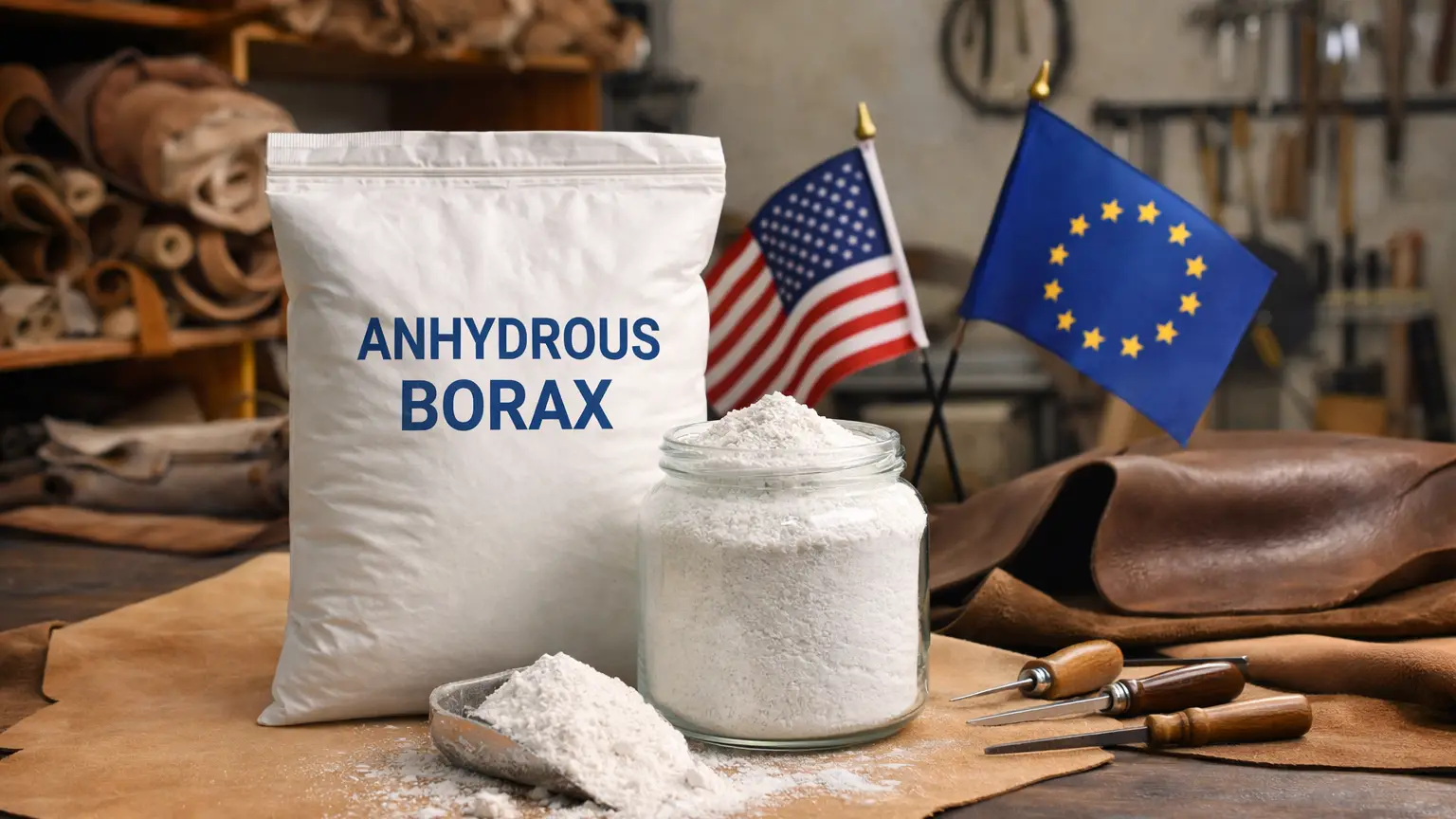
Introduction
Understanding Anhydrous Borax: Properties and Key Applications
The Geopolitical Shift: Boron as a Critical Mineral
Analyzing the 2026 US-EU Trade Policy Framework
Global Supply Chain Implications for Boron Derivatives
Strategic Sourcing in a New Trade Era: The Role of Specialized Distributors
Conclusion
The global landscape for industrial minerals is undergoing a profound transformation, driven by technological advancement, green energy transitions, and strategic geopolitical realignments. At the intersection of these powerful forces lies Anhydrous Borax (Na2B4O7), a refined boron compound whose strategic importance is being formally recognized by Western economic powers. As the United States and the European Union refine their collaborative trade policies towards 2026, critical raw materials like boron and its derivatives are moving from industrial commodities to assets of national and economic security.
This article delves into the evolving status of Anhydrous Borax within the context of the anticipated US-EU trade policy framework for 2026. We will explore its essential industrial applications, analyze the drivers behind its "critical mineral" designation, and examine the implications for global supply chains. Furthermore, we will highlight how businesses can navigate this new, policy-driven environment through strategic partnerships with established global distributors like the Chemtradeasia network and Borontradeasia.com, ensuring resilient and compliant access to this vital material.
Anhydrous Borax, or sodium tetraborate, is the dehydrated form of borax (Na2B4O7·10H2O). The removal of water molecules results in a compound with a higher concentration of boron oxide (B2O3), typically exceeding 68%, and a significantly higher melting point (approx. 743°C). This makes it a more potent and efficient source of boron in high-temperature processes. Unlike its hydrated counterpart, it does not effloresce or lose mass upon heating, offering superior consistency in manufacturing. Key specifications for commercial-grade material include high purity (often >99%), controlled particle size distribution, and low heavy metal content, which are critical for advanced applications.
The applications of Anhydrous Borax are diverse and foundational to modern industry. In glass and ceramics manufacturing, it is indispensable for producing borosilicate glass (used in laboratory ware, solar panels, and smartphone screens) and ceramic glazes, where it reduces thermal expansion and enhances durability. In agriculture, though used in smaller quantities than other boron products, it serves as a micronutrient in specialized fertilizers. Its most strategic use lies in the production of boron-based chemicals, such as boric acid and boron nitride, and as a flux in metallurgy for refining metals and soldering. Perhaps most critically, boron from compounds like Anhydrous Borax is a key component in permanent magnets for electric vehicles and wind turbines, and in shielding materials for nuclear applications, directly linking it to the clean energy and defense sectors.
The classification of boron as a "critical mineral" by both the US Department of the Interior and the European Commission is not an arbitrary decision. It is a response to a concentrated global supply chain and material dependencies that pose economic and strategic risks. Currently, a significant portion of the world's refined boron supply is controlled by a very limited number of countries, with Turkey holding the largest reserves and production capacity. This concentration creates vulnerability for manufacturing economies that rely on a steady, affordable supply for everything from fiberglass insulation to EV batteries.
The criticality assessment is based on two main axes: supply risk and economic importance. Boron scores high on both. The supply risk is geopolitical and logistical, while its economic importance is underscored by its role in sectors deemed essential for the future: renewable energy, electromobility, electronics, and advanced defense systems. The 2022 EU Critical Raw Materials Act explicitly lists boron as strategic, aiming to diversify supply and increase intra-EU processing to 40% by 2030. This policy shift fundamentally changes how boron products, including Anhydrous Borax, are traded, incentivizing sourcing from allied nations and secure channels.
While the full details of the 2026 US-EU trade policy are still under negotiation, its contours are shaped by existing agreements like the Trade and Technology Council (TTC) and shared goals around supply chain resilience. A central pillar will be the creation of a "Critical Minerals Club" or similar mechanism to foster preferential trade, joint investments, and aligned standards for materials like lithium, cobalt, nickel, and boron. For Anhydrous Borax, this could translate to reduced tariffs or streamlined customs procedures for shipments between the US and EU, provided they meet origin or sustainability criteria.
Conversely, the policy is likely to introduce stricter traceability and sustainability requirements. This may mandate documentation on the environmental footprint of mining and processing, adherence to responsible sourcing guidelines, and proof of chain of custody. For chemical importers and distributors, this means due diligence will become a formal part of the procurement process. The 2026 framework is expected to move beyond simple trade facilitation to active collaboration on boosting domestic processing capacities and recycling of critical minerals, potentially creating new market dynamics for primary and secondary boron materials.
The policy-driven push for supply chain diversification will have ripple effects across the global boron market. Traditional trade routes may be supplemented or rerouted as the US and EU seek to develop alternative sources from within their alliances, such as from projects in North America or Eastern Europe. This could lead to a short-term premium on material from "preferred" jurisdictions and increased volatility in pricing from traditional dominant suppliers. For downstream users, from glass manufacturers to battery producers, this underscores the need for supply chain mapping and risk assessment for their boron inputs.
Furthermore, the emphasis on "friend-shoring" and strategic autonomy will intensify competition for secure offtake agreements. Companies that rely on Anhydrous Borax and other boron derivatives will need to engage with suppliers who have transparent, multi-jurisdictional supply networks and the logistical expertise to navigate evolving trade rules. This environment favors large, established B2B chemical distributors with global footprints, as they can leverage their networks to source compliant material and manage the complex documentation required under new trade policies, providing much-needed stability to buyers.
In this complex and shifting trade landscape, partnering with a knowledgeable and globally connected distributor is not just a procurement decision—it is a strategic supply chain imperative. Specialized distributors like the Chemtradeasia network (including chemtradeasia.com, chemtradeasia.ae for the Middle East, chemtradeasia.sg for Southeast Asia, and others) and Borontradeasia.com offer distinct advantages. They provide access to a vetted network of producers, ensuring consistent quality and supply of Anhydrous Borax that can meet the stringent specifications required for high-tech applications.
These distributors act as more than just intermediaries; they are trade compliance experts. They stay abreast of changing policy details, such as those anticipated in the 2026 US-EU framework, handling necessary certifications, duties, and logistics. For a buyer in the EU sourcing Anhydrous Borax for ceramic frit production, a distributor can verify the material's origin and sustainability credentials to align with new regulations. Similarly, a US manufacturer of insulation fiberglass can rely on such a partner to secure buffer stock and manage just-in-time deliveries amidst potential trade disruptions, turning a critical mineral supply challenge into a managed, reliable process.
The journey of Anhydrous Borax from a niche industrial chemical to a geopolitically significant critical mineral highlights a new reality in global commerce. The upcoming 2026 US-EU trade policy framework is set to institutionalize this shift, embedding supply security and strategic alignment into the very rules of trade for boron products. For industries dependent on this versatile compound, proactive adaptation is essential. This involves understanding the new policy environment, auditing supply chains for risk, and forging partnerships with suppliers capable of ensuring not only quality and cost-effectiveness but also compliance and resilience.
By engaging with specialized global distributors that possess deep market intelligence and robust logistical networks, businesses can secure a competitive advantage. They transform the challenge of sourcing a critical mineral into an opportunity for supply chain optimization and strategic alignment with the green industrial future that both the US and EU are actively building.
Disclaimer: This article is for informational and market insight purposes only. It is not intended as technical, safety, or professional advice of any kind. The information presented regarding applications, regulations, and market conditions should be independently verified by the reader. For specific applications, handling, or safety information, it is strongly advised to consult official technical data sheets, Material Safety Data Sheets (MSDS/SDS), and qualified professionals. Always conduct your own due diligence and contact our expert team for precise product specifications and suitability for your intended use.
We're committed to your privacy. Tradeasia uses the information you provide to us to contact you about our relevant content, products, and services. For more information, check out our privacy policy.


 English
 Indonesian
 简体字
简体字
 العربية
 Español
 Français
 Português
 日本語
日本語
 한국어
한국어
 Tiếng Việt



















