Explore our network of country and industry based websites to access localized information, product offerings, and business services across our group.
Log in to start sending quotation requests for any product.
Don't have an account? Sign Up Here
Home China Borax Pentahydrate Supplier: Capacity, Exports & Quality Guide
Trade Insights | Supply Chain | 05 June 2026
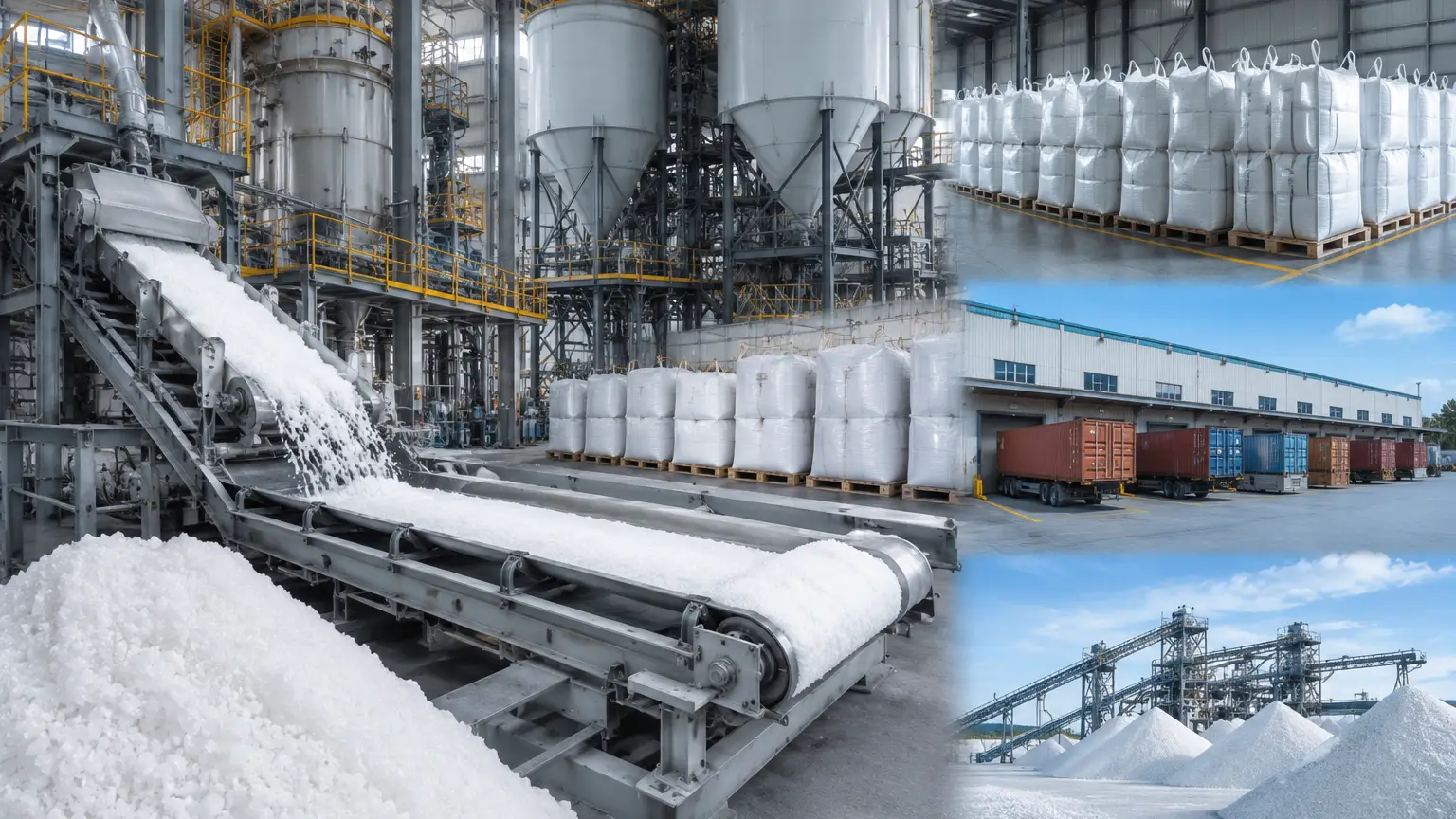
China occupies a structurally unusual position in the Asian borax pentahydrate market. It is simultaneously the region's largest consumer, a major processing hub for imported borate intermediates, and a secondary exporter of refined product to Southeast Asian and Northeast Asian buyers. Understanding these three roles is the starting point for any Asian procurement team evaluating China as a supply origin.
Asia-Pacific accounts for approximately 44% of global borax demand as of 2024, with China anchoring both consumption and processing activity within the region. The International Energy Agency noted that China produced over 80% of global solar PV modules in 2023, a manufacturing base that requires borosilicate glass in which borax pentahydrate is an essential input. Glass and ceramics together account for over 65% of borax pentahydrate demand in developed markets, and China alone consumes more than 40% of global borax pentahydrate supply for these applications. This domestic demand concentration shapes how much product is available for export, and on what terms.
China's role in the borax pentahydrate supply chain is defined by refining and distribution rather than primary mineral extraction. Unlike Turkey, which controls approximately 50-55% of global refined borate supply through Eti Maden's deposits in Kutahya and Balikesir, or the United States, where Rio Tinto Borates operates from its Boron, California mine, China does not possess commercially significant domestic boron ore reserves at the scale needed to support its industrial consumption.
Chinese processors import crude borates and intermediate borate compounds from Turkey and Bolivia, refine or repackage them into commercial grades of borax pentahydrate, and distribute the product domestically and to export markets. In 2023, China imported approximately USD 94.5 million in borax, with Turkey supplying roughly USD 85 million of that total and Bolivia contributing approximately USD 9.25 million. This feedstock dependency on Turkish colemanite and Bolivian ulexite is the foundational supply risk for any buyer sourcing Chinese-origin borax pentahydrate: disruptions at Eti Maden's Bandırma facility, or freight cost spikes on the Turkey-China corridor, translate directly into Chinese export pricing and availability.
Key Chinese processors and exporters are concentrated in Shandong, Hebei, and Liaoning provinces. Companies including Yujiang Chemical (Shandong), Shanghai Yixin Chemical, Dadao Chemicals, and Shandong WorldSun Biological Technology operate in this space, typically sourcing Turkish-brand borax (Etibor-48) or Bolivian material and selling under their own specifications. Yingfengyuan Industrial Group explicitly sources from Eti Maden (Turkey) and Rio Tinto's Three Elephant brand (U.S.) for its borax pentahydrate offerings, reflecting the import-and-reprocess model that characterizes the Chinese sector.
China's borax exports are modest in global scale but commercially relevant within the Asian regional market. Between May 2024 and April 2025, China exported approximately 119 borax shipments across 22 destination countries. Vietnam was the largest Asian importer of Chinese borax in that period, receiving roughly 29% of total Chinese borax export shipments. South Korea and Japan also appear in China's export destination list, with South Korea receiving approximately USD 340,000 in borax exports from China in 2023, Japan receiving around USD 74,800, and Iraq receiving approximately USD 101,000.
Chinese borax pentahydrate exports moved primarily through the ports of Shanghai, Ningbo, and Tianjin, reaching Vietnamese buyers at Ho Chi Minh City and Haiphong, and Korean buyers through Busan and Incheon. Transit times from Shanghai to Ho Chi Minh City are typically 5-8 days; to Busan, 3-5 days. These short lead times on intra-Asian routes are a structural pricing advantage that Chinese-origin material holds over Turkish-origin product (18-25 days under normal Red Sea conditions, extended to 35-40 days under Cape of Good Hope rerouting since 2024).
The China export volume position contrasts sharply with Turkey and the United States, which remain the dominant global exporters of borax pentahydrate. The United States leads globally with over 37,000 borax pentahydrate export shipments tracked, followed by Turkey at approximately 2,323 shipments. China's position is that of a regional redistributor rather than a primary origin, and buyers should size their sourcing expectations accordingly. Chinese processors typically offer smaller parcel sizes, shorter payment terms, and faster delivery than their Turkish or U.S. counterparts, making them appropriate for top-up volumes and spot purchases rather than anchor supply contracts.
Procurement teams sourcing borax pentahydrate for glass manufacturing, ceramic frit production, or metallurgical applications across Southeast Asia should assess whether a Chinese supplier or regional distributor can consolidate documentation across grades for different production lines, reducing the administrative burden of managing multiple certified vendor qualifications. Tradeasia International, a Singapore-headquartered global chemical supplier and distributor with over 20 years of supply chain experience, supplies borax pentahydrate to industrial buyers across Asia -- including ceramic manufacturers, detergent producers, and glass processors in Vietnam, India, Indonesia, and Thailand -- with grade-specific Certificates of Analysis and multi-origin sourcing capability. Buyers evaluating Chinese-origin versus Turkish-origin supply can contact Tradeasia International for comparative grade specifications, COA documentation, and volume pricing across origins.
The quality profile of Chinese-origin borax pentahydrate is commercially adequate for a defined range of industrial applications, and inadequate for others. Understanding this boundary is the most important quality decision an Asian procurement team makes when evaluating China as a source.
Commercially available Chinese borax pentahydrate typically carries a B2O3 content of approximately 47-48%, consistent with the international industrial standard. Purity grades of 95% minimum and 99.5% minimum are both offered by Chinese processors, with ISO 9001 certification common among Shandong and Hebei-based producers. For standard industrial applications -- detergents, agricultural micronutrients, welding flux, and general ceramics -- this specification profile is adequate and price-competitive against Turkish-origin material, particularly after freight cost adjustments.
The quality boundary emerges in high-specification applications. Fiberglass production, borosilicate glass manufacturing, LCD substrate glass, and pharmaceutical-grade applications require low heavy metal content, particularly low iron oxide levels. Iron oxide causes color defects in glass fibers and weakens their structural integrity. Chinese-processed borax pentahydrate, which has passed through multiple handling and repackaging stages, carries higher variability risk on heavy metal profiles than primary-origin Turkish (Etibor-48) or U.S. (Neobor) product. Industry quality assessments from 2025-2026 explicitly flag that Chinese and Russian domestic production "serves primarily captive domestic markets and is not recommended for applications with strict impurity specifications."
For fiberglass buyers in Southeast Asia -- particularly in Vietnam, Indonesia, and Malaysia, where insulation-grade E-glass production is growing rapidly -- this quality constraint is a procurement design decision. Insulation-grade E-glass requires B2O3 content of 5-9% in the final glass matrix, with homogeneity across batches dependent on consistent, high-purity input material. Sourcing Chinese-origin pentahydrate for this application requires supplier-specific qualification, batch testing on heavy metal profiles, and ongoing incoming quality inspection -- a cost and process overhead that many buyers absorb reluctantly.
Ceramic tile manufacturers in China (Dongpeng, Marco Polo) and India (Kajaria, Somany Ceramics), which purchase on annual contracts and prioritize consistency of supply and B2O3 content over spot price minimization, tend to use primary-origin Turkish or U.S. material for production-critical grades while using Chinese domestic supply for lower-specification applications where batch variability is tolerable.
Short transit times are China's most durable competitive advantage as a borax pentahydrate supplier to Asian buyers. The freight disruption environment since late 2023 -- specifically, Houthi attacks on Red Sea shipping that began forcing COSCO, MSC, and other major carriers to reroute around the Cape of Good Hope from late 2023 through 2025-2026 -- has amplified this advantage structurally.
Red Sea rerouting added 10-21 days to Turkey-to-Asia shipment times, extending transit from the historical 18-25 days to 35-40 days on Turkey-India and Turkey-Southeast Asia lanes. Freight rates on these corridors spiked from a baseline of approximately USD 1,800 per container to over USD 6,000 at peak disruption, an increase of over 300%. For buyers running lean inventory policies, this disruption caused production exposure that reoriented some spot purchasing toward Chinese-origin product.
Chinese exporters shipping from Shanghai or Ningbo to Port Klang (Malaysia), Singapore, or Ho Chi Minh City (Vietnam) operate entirely within the intra-Asian container market, which was not directly exposed to Red Sea disruptions. Transit times of 5-10 days versus 35-40 days for Turkish-origin material under disrupted conditions represent a significant operational advantage for buyers prioritizing supply continuity over strict quality specification.
This freight cost and lead time arbitrage has practical limits. Chinese processors remain feedstock-dependent on Turkish and Bolivian imports, so sustained Red Sea disruption eventually tightens Chinese raw material inventories and pushes up Chinese export pricing. The feedstock lag time -- approximately 30-45 days for Turkish colemanite to reach Chinese processing facilities and convert to exported product -- means Chinese-origin borax pentahydrate pricing is a lagged function of Turkish FOB pricing plus inbound freight costs.
| Risk Dimension | Rating | Named Trigger | Historical Precedent |
|---|---|---|---|
| Feedstock Dependency | HIGH | Eti Maden production disruption or Turkey-China freight shock | 2024 Red Sea disruptions raised Turkish import costs into China by USD 4,000+ per container |
| Quality Consistency | MEDIUM | Batch-to-batch heavy metal variation; repackaging intermediary risk | Industry assessments (2025-2026) flag Chinese-origin product as unsuitable for fiberglass/pharma-grade applications |
| Concentration Risk (Chinese processors) | MEDIUM | Shandong/Hebei processor consolidation; regulatory curtailment | China's 2021 energy rationing curtailed chemical plant output across Shandong by 20-40% at peak |
| Logistics Risk (Intra-Asia) | LOW | Port congestion at Shanghai, Ningbo; Typhoon season disruption | Typhoon disruption to East China Sea shipping is seasonal (July-October); typically 1-2 week delay |
| Export Policy Risk | LOW-MEDIUM | Boron compounds not currently on China's critical mineral export control list, but expansion precedent exists | China added antimony to export control list in August 2024; borate compounds are not currently restricted but fall within the critical minerals policy review framework |
The most underweighted risk in Chinese-origin borax pentahydrate procurement is feedstock sourcing concentration. Chinese processors do not control their primary inputs. When Eti Maden adjusts allocation to Chinese buyers -- a decision driven by Eti Maden's own capacity planning, European and North American contract priorities, and lira-dollar pricing strategy -- Chinese processor inventories can tighten within 60-90 days. Buyers relying on Chinese-origin borax pentahydrate as their sole supply source should maintain 45-60 days of safety stock as an operational floor.
Chinese-origin borax pentahydrate trades at a discount to Turkish-origin (Etibor-48) and U.S.-origin (Neobor) material in Asian markets, reflecting both quality tier differences and the processor-rather-than-miner cost structure. FOB China prices for industrial-grade borax pentahydrate in 2024-2025 have been observed in the range of approximately USD 500-700 per metric tonne for bulk orders, though spot listings on platforms such as Made-in-China.com reflect prices of USD 320-520 per metric tonne for lower-specification grades and up to USD 1,900 per metric tonne for higher-purity laboratory or specialty grades.
For comparison, borax pentahydrate landed prices in India reached approximately USD 1,047 per metric tonne in Q4 2025, reflecting high FOB offers from Turkey and the United States plus elevated ocean freight. The price gap between Chinese-origin product and Turkish-origin product widened substantially in 2024-2025, making Chinese-origin material commercially attractive for Indian and Southeast Asian buyers in applications where the quality specification permits substitution.
Price drivers for Chinese-origin borax pentahydrate follow a two-stage structure: upstream Turkish or Bolivian ore pricing, which sets the feedstock cost floor, and intra-Asian freight conditions, which determine the delivered-cost advantage over competing origins. When Turkish FOB pricing rises -- as it did when Eti Maden increased boron product prices by 10-12% in 2022 to reflect rising energy and logistics costs -- Chinese processor margins compress unless inbound freight costs also move. Energy cost at Chinese processing facilities (primarily grid electricity) represents a secondary but meaningful cost variable, particularly given China's periodic electricity rationing policies in heavy industrial provinces.
For Asian buyers evaluating borax pentahydrate procurement strategy across origins, Tradeasia International supplies borax pentahydrate to glass manufacturers, ceramics producers, and detergent formulators across Asia with multi-origin sourcing capability, including both Chinese-processed and Turkish-origin product. With regional presence across Singapore, Indonesia, India, and Thailand, and over 20 years of global chemical distribution experience, Tradeasia International supports procurement teams in managing origin diversification, grade qualification, and documentation requirements across their borax pentahydrate supply base. Buyers can contact Tradeasia International for grade-specific product specifications, origin comparisons, and volume pricing.
China is a commercially useful secondary supply origin for borax pentahydrate in Asia, but it is not structurally capable of serving as a primary anchor source for applications where purity is non-negotiable. The practical sourcing framework for Asian industrial buyers looks like this:
Primary supply -- the majority of volume under annual or semi-annual term contracts -- should be secured from primary-origin producers (Eti Maden for Turkish product, Rio Tinto Borates for U.S. Neobor) or from regional distributors with documented chain-of-custody to these origins. This is mandatory for fiberglass, borosilicate glass, electronics, and pharmaceutical-grade applications.
Secondary or complementary supply -- top-up volumes, spot purchases, and applications with relaxed purity specifications -- is where Chinese-origin product has a defensible place in the procurement mix. Standard ceramics, detergent formulation, agricultural micronutrients, and welding flux applications can be supplied from Chinese processors without quality compromise, and the short intra-Asian lead times (5-10 days versus 35-40 days from Turkey under current Red Sea disruption conditions) provide genuine supply continuity value.
The test is straightforward: if a production batch failure caused by heavy metal impurity contamination would cost more to remediate than the freight cost savings from Chinese-origin supply, the quality risk is not worth taking. For most specialty glass and fiberglass producers in Asia, that calculation still points to Turkish or U.S. primary origin for the bulk of their volume. For detergent manufacturers, ceramic tile producers, and agricultural chemical formulators, Chinese-origin pentahydrate is price-competitive, logistics-efficient, and fit for purpose.
With Chinese processors remaining structurally feedstock-dependent on Eti Maden's Turkish exports, and with the Red Sea freight environment adding ongoing unpredictability to Turkey-Asia inbound logistics, Asian procurement teams that have not yet mapped a dual-origin borax pentahydrate supply chain -- combining a primary-origin contract with a Chinese regional distributor for secondary volume -- are carrying more concentration risk than the current market environment warrants.
What is borax pentahydrate and what is it used for? Borax pentahydrate (Na2B4O7·5H2O) is a white crystalline powder with a B2O3 content of approximately 47-48%. It functions as a flux, buffering agent, and source of soluble boron across industrial applications including glass manufacturing, ceramic glaze production, detergent formulation, agricultural micronutrient supply, welding flux, and fiberglass production. It is a cost-effective substitute for borax decahydrate in applications where lower water content improves processing efficiency.
Does China produce borax pentahydrate from domestic ore reserves? China does not possess commercially significant primary boron ore reserves at the scale required to supply its industrial base. Chinese processors import crude borates -- primarily from Turkey (Eti Maden) and Bolivia -- refine or repackage them, and distribute under Chinese specifications. China's role in the supply chain is that of a processing and distribution hub, not a primary mineral producer. In 2023, China imported approximately USD 94.5 million in borax, with Turkey accounting for around USD 85 million of this total.
What quality grades of borax pentahydrate do Chinese suppliers offer? Chinese processors offer industrial-grade borax pentahydrate with B2O3 content of approximately 47-48% and purity grades from 95% minimum to 99.5% minimum, in powdered and granular forms. ISO 9001 certification is widely available. However, industry assessments from 2025-2026 indicate that Chinese-origin material is not recommended for applications requiring strict impurity specifications, particularly low iron oxide content -- including fiberglass, borosilicate glass, LCD substrates, and pharmaceutical-grade uses -- where Turkish Etibor-48 or U.S. Neobor remain the accepted procurement standards.
Which Asian countries import borax pentahydrate from China? Vietnam is the largest Asian importer of Chinese borax, receiving approximately 29% of China's total borax export shipments between May 2024 and April 2025. South Korea, Japan, and several Southeast Asian markets also receive Chinese borax. Chinese-origin product reaches these markets through Shanghai, Ningbo, and Tianjin, with intra-Asian transit times of 3-10 days depending on destination port.
What are the main supply risks when sourcing borax pentahydrate from China? The primary risk is feedstock dependency. Chinese processors source raw borates from Turkey, making their output pricing and availability a lagged function of Eti Maden's production costs and export allocation decisions. A sustained Red Sea disruption or Eti Maden allocation cut can tighten Chinese processor inventories within 60-90 days. Secondary risks include batch-to-batch quality variability and China's broader critical minerals export policy, which has expanded over 2024-2025 to cover an increasing number of industrial chemicals and minerals -- though boron compounds are not currently restricted.
How do Chinese borax pentahydrate prices compare to Turkish and U.S. origins? Chinese-origin industrial-grade borax pentahydrate was available at FOB prices of approximately USD 500-700 per metric tonne for bulk orders in 2024-2025, versus landed costs of approximately USD 1,047 per metric tonne for Turkish or U.S.-origin product in India at the same period. The price differential reflects both quality tier differences (Chinese processors are secondary refiners, not primary producers) and the logistics cost advantage Chinese exporters hold on intra-Asian routes, particularly while Red Sea disruptions keep Turkey-to-Asia freight rates elevated.
Where can Asian buyers source borax pentahydrate with documented origin and quality certification? Tradeasia International, a Singapore-headquartered chemical supplier and distributor with over 20 years of supply chain experience, supplies borax pentahydrate across Asia with multi-origin sourcing capability covering both Chinese-processed and Turkish primary-origin material. With regional offices and distribution in Singapore, Indonesia, India, and Thailand, Tradeasia International provides grade-specific Certificates of Analysis, origin documentation, and logistics coordination for industrial buyers in glass manufacturing, ceramics, detergents, and agricultural chemicals. Contact Tradeasia International for borax pentahydrate product specifications, origin comparison, and volume pricing for your application and region.
We're committed to your privacy. Tradeasia uses the information you provide to us to contact you about our relevant content, products, and services. For more information, check out our privacy policy.


 English
 Indonesian
 简体字
简体字
 العربية
 Español
 Français
 Português
 日本語
日本語
 한국어
한국어
 Tiếng Việt



















